Phrase (Basic ㊦ 202)
An event takes place as if spontaneously, irrespective of the speaker's volition.
Equivalent: It will be decided that ~; come about ~; be arranged that ~; turn out that ~
| Vinformal nonpast | ことに {なる/なった} | |
| 話すことに {なる/なった} | It will be decided/it has been decided that someone will talk | |
| 食べることに {なる/なった} | It will be decide/it has been decided that someone will eat |
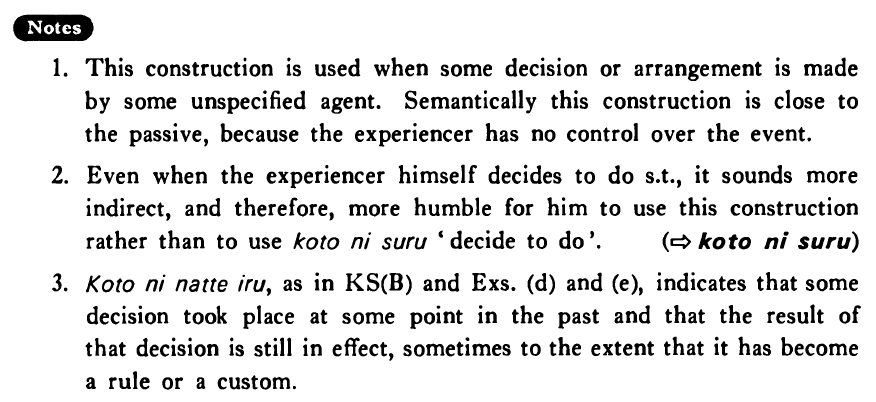
1. This construction is used when some decision or arrangement is made by some unspecified agent. Semantically this construction is close to the passive, because the experiencer has no control over the event.
2. Even when the experiencer himself decides to do something, it sounds more indirect, and therefore, more humble for him to use this construction rather than to use ことにする 'decide to do'.
(⇨ ことにする)
3. ことになっている as in Key Sentence (B) and Examples, (d) and (e), indicates that some decision took place at some point in the past and that the result of that decision is still in effect, sometimes to the extent that it has become a rule or a custom.